

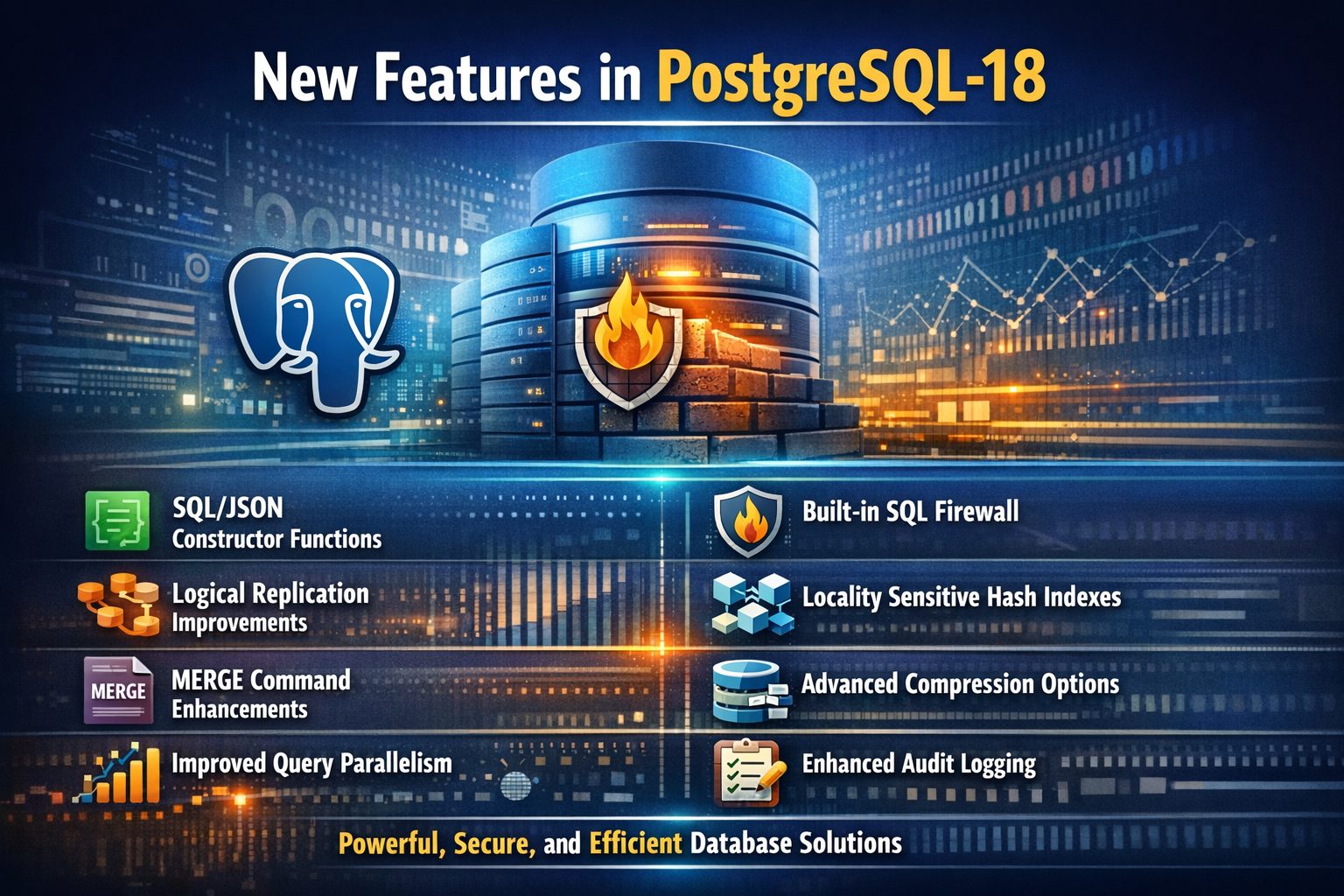
PostgreSQL 18: Revolutionary Changes in Database Performance and Functionality-
PostgreSQL 18, released on September 25, 2025, is one of the most significant updates in years. It brings major improvements to I/O, query processing, and data management, offering enhanced performance and powerful new features for developers, DBAs, and organizations.
These are the Game-Changing Performance Enhancements in PostgreSQL 18
- Asynchronous I/O Subsystem: The Most Significant Addition
PostgreSQL 18 introduces a powerful new asynchronous I/O (AIO) subsystem, allowing parallel data reads and reducing wait times. This marks a major shift from the previous synchronous I/O, significantly improving performance
- Key Benefits of Asynchronous I/O:
-
- Increased I/O Throughput: Multiple read requests can be queued and processed simultaneously
- Reduced Latency: I/O operations no longer block query execution
- Better Resource Utilization: More efficient use of storage subsystems
- Enhanced Performance: Particularly beneficial for sequential scans, bitmap heap scans, and vacuum operations
- Configuration Options:
-
- io_method: Controls the I/O method (enables AIO)
- io_combine_limit and io_max_combine_limit: Control I/O operation combining
- pg_aios: New system view to monitor asynchronous I/O file handles
Asynchronous I/O Configuration in PostgreSQL 18
Check the current I/O method
| 1 2 3 4 5 | testdb=# SHOW io_method; (1 row) io_method ----------- worker |
- Enable asynchronous I/O
| 1 2 3 4 5 6 7 8 9 10 | testdb=# SHOW io_combine_limit; io_combine_limit ------------------ 128kB (1 row) testdb=# SHOW io_max_combine_limit; io_max_combine_limit ---------------------- 128kB (1 row) |
- Monitor asynchronous I/O handles
| 1 2 3 4 5 6 | testdb=# SELECT * FROM pg_aios LIMIT 5; pid | io_id | io_generation | state | operation | off | length | target | handle_data_len | raw_result | result | target_desc | f_sync | f_localmem | f_buffer ed -----+-------+---------------+-------+-----------+-----+--------+--------+-----------------+------------+--------+-------------+--------+------------+--------- --- (0 rows) |
- Parallel GIN Index Building:
PostgreSQL 18 adds parallel builds for GIN indexes, speeding up index creation for JSON and full-text search data.
-
- JSON and JSONB data
- Full-text search columns
- Array data types
- Other complex data structure
- Parallel GIN Index Building
| 1 2 3 4 5 6 7 8 9 10 11 12 | testdb=# CREATE TABLE docs(id serial, content jsonb); CREATE TABLE testdb=# INSERT INTO docs (content) testdb-# VALUES ('{"key": "value", "count": 10}'::jsonb); INSERT 0 1 testdb=# SELECT jsonb_build_object('text', md5(random()::text)) FROM generate_series(1, 50000); jsonb_build_object ---------------------------------------------- {"text": "75ea8a8788ab2f5817cb68499ae581f0"} {"text": "46932c038a966472df32fa4937e8aa65"} {"text": "d479ddb89fd7d1d9355bc723632350f1"} {"text": "722227f05df276d241849e376f473b77"} |
- Parallel GIN index creation
Set the Session Parallelism
| 1 2 | testdb=# SET max_parallel_maintenance_workers = 4; SET |
Create Parallel GIN index
| 1 2 | testdb=# CREATE INDEX gin_docs_idx ON docs USING gin (content jsonb_path_ops); CREATE INDEX |
– Verify in pg_stat_progress_create_index
| 1 2 3 4 5 6 | testdb=# SELECT * FROM pg_stat_progress_create_index WHERE command = 'CREATE INDEX'; pid | datid | datname | relid | index_relid | command | phase | lockers_total | lockers_done | current_locker_pid | blocks_total | blocks_done | tuples_total | tuples_done | partitions_total | partitions_done -----+-------+---------+-------+-------------+---------+-------+---------------+--------------+--------------------+--------------+-------------+-------------- +-------------+------------------+----------------- (0 rows) |
- Advanced Query Optimization Improvements in PostgreSQL 18,
-
- Self-Join Elimination: PostgreSQL 18 can automatically remove unnecessary table self-joins, simplifying query execution plans and improving performance.
- Enhanced OR-Clause Processing: PostgreSQL 18’s optimizer now turns OR clauses into arrays, making index use faster and queries more efficient.
- Right Semi Join Support: PostgreSQL 18 adds Hash Right Semi Join, letting the planner choose which table to hash based on size, improving semi-join performance.
- Skip Scans for B-tree Indexes: Multi-column B-tree indexes can now be used by queries that only reference the second or later indexed columns through skip scan functionality.
- Self-Join Elimination Example
| 1 2 3 4 5 6 7 8 9 10 11 12 13 14 | testdb=# INSERT INTO employees VALUES (1, NULL, 'CEO'), (2, 1, 'Manager'), (3, 2, 'Developer'); INSERT 0 3 testdb=# EXPLAIN SELECT e1.name, e2.name AS manager FROM employees e1 JOIN employees e2 ON e1.manager_id = e2.id; QUERY PLAN ----------------------------------------------------------------------------- Merge Join (cost=166.75..280.75 rows=7200 width=64) Merge Cond: (e1.manager_id = e2.id) -> Sort (cost=83.37..86.37 rows=1200 width=36) Sort Key: e1.manager_id -> Seq Scan on employees e1 (cost=0.00..22.00 rows=1200 width=36) -> Sort (cost=83.37..86.37 rows=1200 width=36) Sort Key: e2.id -> Seq Scan on employees e2 (cost=0.00..22.00 rows=1200 width=36) (8 rows) |
- Skip Scan on Multi-column Index
| 1 2 3 4 | testdb=# CREATE TABLE orders(order_id int, customer_id int, order_date date); CREATE TABLE testdb=# CREATE INDEX orders_idx ON orders(customer_id, order_date); CREATE INDEX |
- Query using skip scan (only order_date)
| 1 2 3 4 5 6 7 8 | testdb=# EXPLAIN SELECT * FROM orders WHERE order_date > CURRENT_DATE - INTERVAL '30 days'; QUERY PLAN ---------------------------------------------------------------------------- Bitmap Heap Scan on orders (cost=19.63..41.53 rows=680 width=12) Recheck Cond: (order_date > (CURRENT_DATE - '30 days'::interval)) -> Bitmap Index Scan on orders_idx (cost=0.00..19.46 rows=680 width=0) Index Cond: (order_date > (CURRENT_DATE - '30 days'::interval)) (4 rows) |
These are the Advanced Data Management Features in PostgreSQL 18
- Virtual Generated Columns:
PostgreSQL 18 introduces virtual generated columns as the default behavior, representing a significant shift from the previous stored-only approach:
- Virtual vs. Stored Generated Columns:
-
- Virtual: Values are computed when the column is read (default in PostgreSQL 18)
- Stored: Values are computed and stored when the row is written (available via STORED option)
- Benefits of Virtual Generated Columns:
-
- Reduced storage requirements
- Always up-to-date values without maintenance overhead
- Better performance for columns that are read infrequently
- Virtual Generated Columns
| 1 2 3 4 5 6 7 8 9 10 11 12 13 14 15 | testdb=# CREATE TABLE sales ( testdb(# id serial, testdb(# price numeric, testdb(# quantity int, testdb(# total numeric GENERATED ALWAYS AS (price * quantity) VIRTUAL testdb(# ); CREATE TABLE testdb=# INSERT INTO sales (price, quantity) VALUES (100, 5), (200, 2); INSERT 0 2 testdb=# SELECT * FROM sales; id | price | quantity | total ----+-------+----------+------- 1 | 100 | 5 | 500 2 | 200 | 2 | 400 (2 rows) |
- Enhanced UUID Support:
UUIDv7 Generation: PostgreSQL 18introduces uuidv7(), a new time-sortable UUID version that provides globally unique, non-predictable IDs ideal for ordered data storage and retrieval:
-
- Time-series data
- Distributed systems requiring ordered identifiers
- Primary keys where chronological ordering is beneficial
Time-sortable UUID: ChatGPT said:
Time-sortable UUIDs: It include a time-based component, allowing efficient sorting and improving database performance compared to random UUIDs like UUIDv4
- uuidv7() example
| 1 2 3 4 5 | testdb=# SELECT uuidv7(); uuidv7 -------------------------------------- 0199ca8c-692d-769d-812c-5f9054168fa1 (1 row) |
- Time-sortable UUID example
- Explicit UUIDv4 Generation: The UUIDv4 is a “purely random” 128-bit identifier, mostly generated from high-quality randomness, with a few bits set by the RFC 9562 standard to define version and variant.12345testdb=# SELECT uuidv7() AS time_sortable_uuid;time_sortable_uuid--------------------------------------0199ca8d-cbd0-7c4a-9afb-97a5266c2505(1 row)
| 1 2 3 4 5 | testdb=# SELECT uuidv4() AS random_uuid; random_uuid -------------------------------------- 9945163f-616f-467e-9ece-fb110b2cb6e0 (1 row) |
- Improved NOT NULL Constraint Management:
Improved NOT NULL constraint management is active in recent PostgreSQL versions (particularly since PostgreSQL 11, with further enhancements in 17 and 18), focusing on two main areas:
-
- Zero-downtime schema changes for large tables.
- Query performance optimization by leveraging constraint knowledge.
- NOT NULL Constraint Improvements
- Named NOT NULL Constraints: You can now assign names to NOT NULL constraints, improving error messages and constraint management.123456testdb=# CREATE TABLE customers (testdb(# id serial PRIMARY KEY,testdb(# name text,testdb(# email texttestdb(# );CREATE TABLE
- NOT VALID Support: NOT NULL constraints can be marked as NOT VALID, allowing for non-blocking constraint addition on large tables.
- Inheritance Control: NOT NULL constraints can now be made inheritable or non-inheritable on partitioned tables.
- Add NOT NULL constraint with a name and NOT VALID option
| 1 2 | testdb=# ALTER TABLE customers ADD CONSTRAINT nn_email CHECK (email IS NOT NULL) NOT VALID; ALTER TABLE |
- Validate constraint later
| 1 2 | testdb=# ALTER TABLE customers VALIDATE CONSTRAINT nn_email; ALTER TABLE |
Enhanced Developer Experience in PostgreSQL 18
- RETURNING Clause Enhancements
The RETURNING clause now supports OLD/NEW syntax, allowing developers to access both old and new values in DML operations:
This feature is particularly useful for:
-
- Aduit trails
- Change tracking
- Data migration scenarios
- RETURNING Clause with OLD/NEW
- 123456789101112testdb=# CREATE TABLE employees_audit(id serial, name text, salary numeric);CREATE TABLEtestdb=# INSERT INTO employees_audit(name, salary) VALUES ('Alice', 50000);INSERT 0 1testdb=#testdb=# UPDATE employees_audittestdb-# SET salary = salary * 1.1testdb-# RETURNING old.salary AS old_salary, new.salary AS new_salary;old_salary | new_salary------------+------------50000 | 55000.0(1 row)
Advanced JSON Functionality
-
- Improved NULL Handling: JSONB null values can now be cast to scalar types as NULL, improving flexibility in JSON data processing.
- Enhanced Array Processing: New optional parameters in json{b}_strip_nulls() allow removal of null array elements.
- JSON Enhancements
| 1 2 3 4 | testdb=# CREATE TABLE json_test(data jsonb); CREATE TABLE testdb=# INSERT INTO json_test VALUES ('{"a":1,"b":null,"c":[1,null,3]}'); INSERT 0 |
- Remove null array elements
| 1 2 3 4 5 | testdb=# SELECT jsonb_strip_nulls(data, true) FROM json_test; jsonb_strip_nulls ----------------------- {"a": 1, "c": [1, 3]} (1 row) |
- NULL casting example
- 12345testdb=# SELECT (data->>'b')::int IS NULL AS null_cast_check FROM json_test;null_cast_check-----------------t(1 row)
New Array Functions:
- array_sort(): Sorts an array’s first dimension
- array_reverse(): Reverses an array’s first dimension
- reverse(): Reverses bytea bytes
- New Array Functions
| 1 2 3 4 5 6 7 8 9 10 11 12 | testdb=# SELECT array_sort(ARRAY[5,2,9,1]) AS sorted, array_reverse(ARRAY[1,2,3,4]) AS reversed; sorted | reversed -----------+----------- {1,2,5,9} | {4,3,2,1} (1 row) testdb=# SELECT reverse('PostgreSQL18'::bytea); reverse ---------------------------- \x38314c515365726774736f50 (1 row) |
- Case Folding Support: The new casefold() function enables advanced, language-aware case-insensitive text matching beyond simple lower/upper conversions.
- Case Folding
| 1 2 3 4 5 6 7 8 | testdb=# SELECT lower('Straße') AS folded_german, testdb-# lower('İstanbul') AS folded_turkish; folded_german | folded_turkish ---------------+---------------- straße | istanbul (1 row) Time: 17.053 ms |
Security and Authentication Improvements PostgreSQL 18
- OAuth (open-authorization) Authentication Support:
PostgreSQL 18 introduces built-in Open-Authorization authentication support, modernizing authentication capabilities:
-
- OAuth authentication method in pg_hba.conf
- libpq OAuth connection options
- Integration with modern identity providers
- Enhanced SSL/TLS Configuration
-
- TLS 1.3 Cipher Suites: The New ssl_tls13_ciphers parameter allows specification of multiple TLS 1.3 cipher suites.
- Extended Curve Support: The ssl_groups parameter (renamed from ssl_ecdh_curve) now supports multiple elliptic curves, including X25519.
- Security Key Improvements: Cancel request keys are now 256 bits, enhancing security when using wire protocol version 3.2.
- Deprecation of MD5 Passwords
PostgreSQL 18 officially deprecates MD5 password authentication:
-
- CREATE ROLE and ALTER ROLE now emit warnings for MD5 passwords
- MD5 support will be removed in a future major version
- Organizations should migrate to SCRAM-SHA-256 authentication
Monitoring and Observability in PostgreSQL 18
- Enhanced Statistics Collection:
- Detailed I/O Statistics: New columns in pg_stat_io report I/O activity in bytes (read_bytes, write_bytes, extend_bytes).
- WAL I/O Monitoring: WAL receiver activity is now tracked in pg_stat_io with dedicated wait events.
- Parallel Worker Statistics: New columns in pg_stat_database track parallel worker launch and execution metrics.
- Enhanced I/O Stats
| 1 2 3 4 5 6 7 8 9 10 11 12 13 14 | testdb=# SELECT backend_type, testdb-# object, testdb-# read_bytes, testdb-# write_bytes testdb-# FROM pg_stat_io testdb-# WHERE read_bytes > 0; backend_type | object | read_bytes | write_bytes -------------------+----------+------------+------------- client backend | relation | 5505024 | 0 autovacuum worker | relation | 106496 | 0 startup | wal | 32768 | 0 (3 rows) Time: 65.021 ms |
- WAL I/O Monitoring
| 1 2 3 4 5 6 7 8 9 10 11 12 13 14 15 16 17 | testdb=# SELECT * testdb-# FROM pg_stat_io testdb-# WHERE object = 'WAL'; backend_type | object | context | reads | read_bytes | read_time | writes | write_bytes | write_time | writebacks | writeback_time | extends | extend_bytes | extend_time | hits | evictions | reuses | fsyncs | fsync_time | stats_reset --------------+--------+---------+-------+------------+-----------+--------+-------------+------------+------------+----------------+---------+--------------+- ------------+------+-----------+--------+--------+------------+------------- (0 rows) Time: 7.194 ms testdb=# SELECT DISTINCT object FROM pg_stat_io; object --------------- wal temp relation relation (3 rows) |
- Improved EXPLAIN Functionality:
-
- Automatic BUFFERS Output: EXPLAIN ANALYZE now automatically includes buffer usage information.
- Enhanced Node Details: Additional memory and disk usage details for Material, Window Aggregate, and CTE nodes.
- Fractional Row Counts: EXPLAIN now outputs fractional row counts for more accurate cost estimates.
- EXPLAIN Enhancements
| 1 2 3 4 5 6 7 8 9 10 11 12 | testdb=# EXPLAIN (ANALYZE, BUFFERS) testdb-# SELECT * FROM sales WHERE total > 100; QUERY PLAN ------------------------------------------------------------------------------------------------------ Seq Scan on sales (cost=0.00..25.53 rows=270 width=72) (actual time=4.675..4.701 rows=2.00 loops=1) Filter: ((price * (quantity)::numeric) > '100'::numeric) Buffers: shared hit=1 Planning Time: 7.938 ms Execution Time: 8.154 ms (5 rows) Time: 39.339 ms |
Replication and High Availability in PostgreSQL 18
- Generated Column Replication
PostgreSQL 18 allows generated column values to be logically replicated, controlled by the new publish_generated_columns option..
- Generated Column Replication
- Enhanced Subscription Management:
-
- Default Streaming Mode: CREATE SUBSCRIPTION now defaults to parallel streaming mode instead of off.
- Two-Phase Commit Flexibility: ALTER SUBSCRIPTION can now modify replication slot two-phase commit behavior.
- Improved Conflict Resolution
Enhanced logging and monitoring of conflicts during logical replication, with new columns in pg_stat_subscription_stats for detailed conflict tracking.
Administrative and Operational Improvements in PostgreSQL 18
- Vacuum and Maintenance Enhancements:
-
- Eager Page Freezing: VACUUM can now freeze some all-visible pages even during normal operations, controlled by vacuum_max_eager_freeze_failure_rate.
- Truncation Control: New vacuum_truncate server variable controls file truncation during VACUUM operations.
- Enhanced Vacuum Statistics: Detailed timing information for vacuum and analysis operations, including delay time reporting.
- VACUUM Enhancements
| 1 2 3 4 5 6 7 8 9 10 11 12 13 14 15 16 17 18 19 20 21 22 23 24 25 26 27 28 29 | testdb=# VACUUM (VERBOSE) sales; INFO: vacuuming "testdb.public.sales" INFO: finished vacuuming "testdb.public.sales": index scans: 0 pages: 0 removed, 1 remain, 1 scanned (100.00% of total), 0 eagerly scanned tuples: 0 removed, 2 remain, 0 are dead but not yet removable removable cutoff: 807, which was 0 XIDs old when operation ended new relfrozenxid: 789, which is 1 XIDs ahead of previous value frozen: 0 pages from table (0.00% of total) had 0 tuples frozen visibility map: 1 pages set all-visible, 0 pages set all-frozen (0 were all-visible) index scan not needed: 0 pages from table (0.00% of total) had 0 dead item identifiers removed avg read rate: 0.000 MB/s, avg write rate: 0.986 MB/s buffer usage: 20 hits, 0 reads, 6 dirtied WAL usage: 5 records, 6 full page images, 38403 bytes, 0 buffers full system usage: CPU: user: 0.04 s, system: 0.00 s, elapsed: 0.04 s INFO: vacuuming "testdb.pg_toast.pg_toast_24665" INFO: finished vacuuming "testdb.pg_toast.pg_toast_24665": index scans: 0 pages: 0 removed, 0 remain, 0 scanned (100.00% of total), 0 eagerly scanned tuples: 0 removed, 0 remain, 0 are dead but not yet removable removable cutoff: 807, which was 0 XIDs old when operation ended new relfrozenxid: 807, which is 19 XIDs ahead of previous value frozen: 0 pages from table (100.00% of total) had 0 tuples frozen visibility map: 0 pages set all-visible, 0 pages set all-frozen (0 were all-visible) index scan not needed: 0 pages from table (100.00% of total) had 0 dead item identifiers removed avg read rate: 0.727 MB/s, avg write rate: 0.727 MB/s buffer usage: 25 hits, 1 reads, 1 dirtied WAL usage: 2 records, 1 full page images, 7495 bytes, 0 buffers full system usage: CPU: user: 0.01 s, system: 0.00 s, elapsed: 0.01 s VACUUM Time: 75.587 ms |
- Adjust eager freeze rate
| 1 2 3 4 5 6 | testdb=# SET vacuum_max_eager_freeze_failure_rate = 0.05; SET Time: 6.117 ms testdb=# SET vacuum_truncate = on; SET Time: 0.230 ms |
- Flexible Autovacuum Configuration:
-
- Worker Slot Management: New autovacuum_worker_slots parameter allows dynamic adjustment of autovacuum workers without server restart.
- Threshold Configuration: autovacuum_vacuum_max_threshold allows specification of fixed dead tuple counts for triggering autovacuum.
- Autovacuum Worker Slots
| 1 2 3 4 5 6 7 | testdb=# SHOW autovacuum_worker_slots; autovacuum_worker_slots ------------------------- 16 (1 row) Time: 7.151 ms |
- Backup and Recovery Improvements:
-
- pg_combinebackup Enhancements: New –link option enables hard linking for faster backup combinations.
- Tar Format Verification: pg_verifybackup now supports verification of tar-format backups.
- Enhanced pg_upgrade: Statistics preservation during major version upgrades, parallel database checks, and new –swap mode for potentially faster upgrades.
Client and Tool Enhancements
- psql Improvements
-
- Pipeline Query Support: New commands for issuing pipeline queries (\startpipeline, \syncpipeline, etc.).
- Enhanced Information Display: Improved \conninfo output with tabular format and additional connection details.
- Expanded Mode for Lists: All list commands can now use expanded mode with the x suffix. (\x) command for expanded enable or disable.
- Connection and Protocol Enhancements
-
- Protocol Version Control: New libpq parameters to specify minimum and maximum acceptable protocol versions.
- Search Path Reporting: Changes to search_path are now reported to clients.
- SSL Key Logging: New sslkeylogfile parameter for debugging SSL connections.
Infrastructure and Platform Updates
- Build System and Dependencies:
- Meson on Windows: Meson builds are no longer experimental on Windows platforms.
- Updated Requirements:
-
- Minimum Python version: 3.6.8
- OpenSSL: Version 1.1.1 or later required
- LLVM: Version 14 or later if enabled
- NUMA (Non-Uniform Memory Access) Awareness:
New-with-libnuma configure option enables NUMA awareness, with supporting functions: It’s introduced on PostgreSQL version 18, and it is valid for later versions.
-
- pg_numa_available(): Reports NUMA availability
- pg_shmem_allocations_numa and pg_buffercache_numa: NUMA-aware system views
Migration and Compatibility Considerations
- Breaking Changes
-
- Data Checksums Default: initdb now enables data checksums by default. Use –no-data-checksums to disable.
- Time Zone Handling: Session time zone abbreviations are now favored over the server timezone_abbreviations setting.
- VACUUM Behavior: VACUUM and ANALYZE now process inheritance children by default. Use the new ONLY option for previous behavior.
- Upgrade Path
-
- Statistics Preservation: pg_upgrade can now preserve optimizer statistics, reducing post-upgrade analysis time.
- Parallel Checks: Database checks during upgrade can now run in parallel, significantly reducing upgrade time.
- Checksum Compatibility: pg_upgrade requires matching checksum settings between clusters.
Performance Impact and Real-World Benefits in PostgreSQL 18
- Expected Performance Improvements
-
- I/O-Bound Workloads: Applications with heavy read patterns will see the most dramatic improvements from asynchronous I/O.
- Index-Heavy Operations: Parallel GIN index builds and enhanced B-tree skip scans will significantly benefit search-intensive applications.
- Large Table Maintenance: Improved vacuum strategies and parallel operations reduce maintenance windows.
- Industry-Specific Benefits
-
- Analytics and Reporting: Enhanced query optimization and parallel processing benefit OLAP workloads.
- Full-Text Search: Parallel GIN index building and improved JSON handling enhance search applications.
- Time-Series Data: UUIDv7 support and virtual generated columns optimize time-series workloads.
Looking Forward
PostgreSQL 18 marks a key shift toward more efficient, scalable operations, with async I/O boosting its competitiveness while keeping reliability and standards intact.
Key areas where PostgreSQL 18 excels:
-
- Performance: Asynchronous I/O and query optimization improvements
- Scalability: Enhanced parallel processing and better resource utilization
- Developer Experience: Improved SQL features and better tooling
- Operations: Enhanced monitoring and flexible maintenance options
- Security: Modern authentication methods and improved SSL/TLS support
Conclusion
PostgreSQL 18 delivers on the promise of modern database performance while maintaining PostgreSQL’s commitment to reliability and standards compliance. The introduction of asynchronous I/O, enhanced query optimization, and improved developer features make this release a compelling upgrade for organizations of all sizes.





1 Comment